



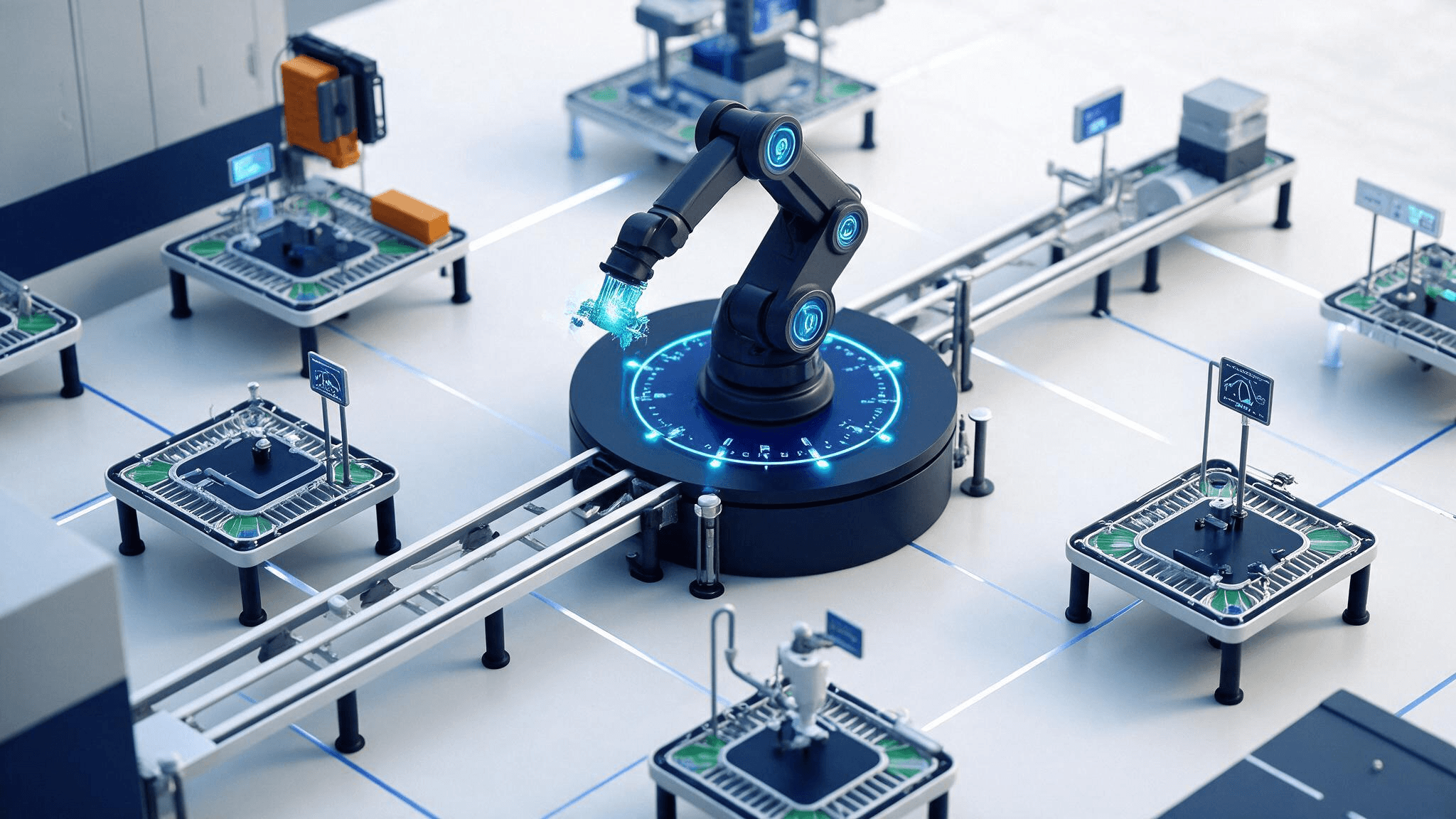
Before01
Company profile
- Manual part alignment
- Long setup times
- Repetition injury risk
DX Solution
Robotic process automation that transforms production
SYSTEM ARCHITECTURE
From the RPA automation layer down to the equipment on the floor, four layers connected as one data flow.
RPA
RPA automation layer
Automation Layer
Orchestrator (RPA controller)
 Scheduler
 Workload management
 Logging and audit trail
 Dashboard
Bot/Execution Engine
 Trigger receiver
 Data Mapper/ETL
 Action executor
 Exception handling module
L3
Execution layer
Execution Layer
Data Management
Logic & Event Engine
Interface Layer
AI/ML engine
 Unstructured data processing (OCR & NLP)
 Anomaly detection and forecasting
 Intelligent exception handling
 Vision-based quality inspection
L2
Transport layer
Transport Layer
OPC-UA based integration interface
AAS MODEL
 JSON
JSON CSV
CSVL1
Field
Field Layer
Equipment controllers
 PLCProduction equipment
 CNCMachine tools
IOT & SENSOR
 Machine vision
 SENSOR
 RFID
RFIDRobots
 Humanoid
 Cobot
Cobot Industrial robot
 AGV / AMR
ARCHITECTURE PROCESS
Four stages, from assessment and design through installation and validation to training and maintenance.


EFFECT
What the work handed to robots leaves behind — in output, quality, working environment and cost.
BUSINESS OUTCOME
Higher output
Running 24/365 without interruption and handling tasks far faster than a person does, cutting processing time.
Uptime · output · tact time
Better quality
Errors from manual and simple repetitive work are removed and variation is reduced, keeping quality consistent.
Defect rate · quality variation · rework rate
Improved working environment
Less stress and fatigue from repetitive work raises job satisfaction and widens the use of digital tools on the floor.
Hazardous-task share · fatigue · job satisfaction
Cost reduction
Labour costs are streamlined and operating costs cut directly, with people redeployed to higher-value work such as planning and response.
Labour cost · operating cost · redeployment
CASE STUDY
A part-alignment process handed to robots, with shop-floor data linked to the MES in real time.

Customer industry
Precision cutting tool manufacturing
Before01
After02
Results
Robot automation that turned a manual alignment process into unattended operation
Redraw the line between what people do and what robots do.
We review your repetitive and hazardous tasks, then name the robot class and the payback period.
Talk to us
